Be the first to call.
You can’t bill the hours you spend finding clients. Aperture finds them for you and sends them to your inbox every morning.
Our workbook drafts it. You confirm it.
Each one is checked against your clients and contacts.
Every morning: who to call and what to say.
You didn’t go to law school to run a funnel.
You’d rather be billing. Business development competes with client work, so it happens in scraps: a lunch here, a conference there, whoever you happened to know.
Bought lists, cold outreach, “leads” that are just names. Lawyers don’t buy from funnels, and neither do their clients. Work comes from relationships and timing.
Your partner knows the general counsel. You know the case. Nobody knows both until the engagement letter goes to another firm. Cross-selling depends on hallway luck.
Aperture fixes the inputs: the right case, the right contact, the right colleague — every morning, while you bill.
See what arrives in your inbox.
Open any item for the parties, the claims, your relationships on both sides of the caption, and a recommended action.
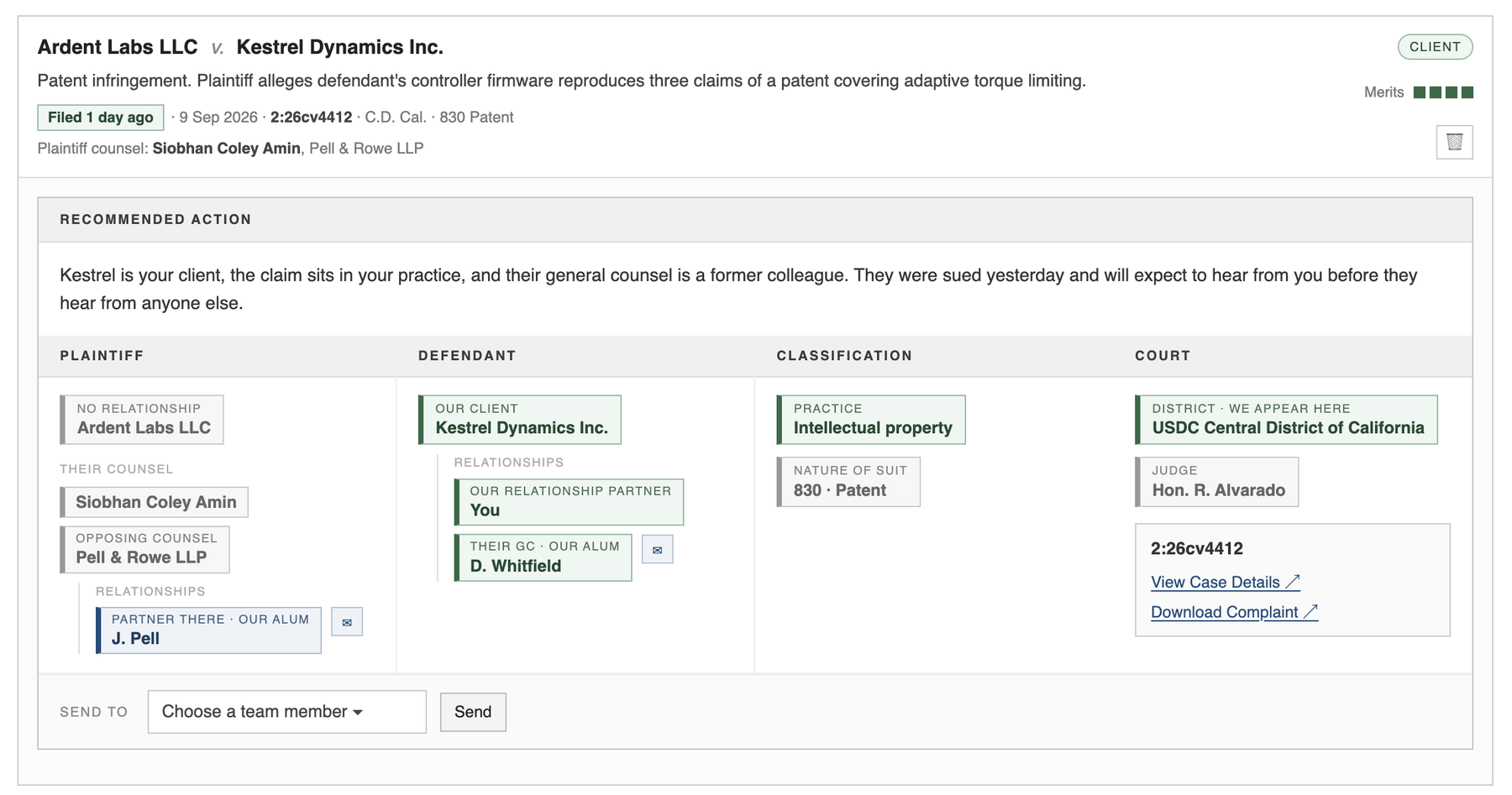
From case to conversation.
Reading the market is half the job. Aperture turns every item into the next move: the right person to contact, the words to reach them with, and the colleague to loop in.
Every report names who to reach: the general counsel you already know, the decision-maker a colleague knows, the client who will want to hear it from you before anyone else calls.
Aperture drafts the outreach for each item: grounded in the filing, aware of your relationship to the parties, and ready to edit and send from your own inbox. You approve every word.
Every case shows who else on your team knows the company, holds the relationship, or works the practice area — governed by per-contact confidentiality controls and ethical walls.
When a case is a better fit for someone else, send it with the report and relationships attached. Their opportunity to win, your referral, the firm’s revenue. Cross-selling stops depending on hallway luck.
Your data stays yours.
We know how important privacy is, and we take it seriously. This is not another chatbot and there is no prompt box to master. Aperture works automatically, shows its sources, and treats your relationship data the way you treat client confidences. We will never share your data or use it for marketing.
Your data is never shared, never used for marketing, and never used to train shared models.
Per-contact confidentiality flags; imported relationship data is yours alone.
Public evidence, licensed enrichment, and lawyer-confirmed facts are kept distinct — and never conflated.
Every summary carries citations and a direct link to the complaint or filing behind it.
From one lawyer to the whole firm.
Aperture is built for wherever origination lives: a single litigator building a book, a boutique, a midsize firm, or a large firm coordinating hundreds of relationships. If one timely client conversation can pay for the product for years, we built this for you.
Start today. Cancel anytime.
Signup is a breeze and you’ll have your first case in your inbox in minutes.
See what Aperture sees. One qualified case a day, in your inbox. Upgrade any time.
The full daily briefing, built around your clients and practice.
Team plans include firm-wide coordination, shared relationship visibility, and ethical walls. Questions? Talk to us.
Questions lawyers ask first.
New complaints and filings in the courts you choose, federal and state, continuously. Watch only where you practise, or watch everything.
In your inbox every morning as an email. Each item opens into the full report, with the complaint and every source linked.
Very little. Run our workbook prompt in the AI tool you already use; it drafts your practice profile, and you confirm it in Aperture. Contacts come from Outlook or CRM exports whenever you’re ready; nothing blocks your first briefing.
One qualified case each morning, with the complaint summarized, the reason it reached you, and the source linked. Upgrade to the full briefing any time.
No. Aperture is business-development intelligence: it tells you who was sued, why the case touches your clients and relationships, and why it may be worth a call. It is not legal advice.
You, unless you choose to share it with your firm. Contacts carry per-person confidentiality flags, and your data is never used to train shared models without explicit authorization.